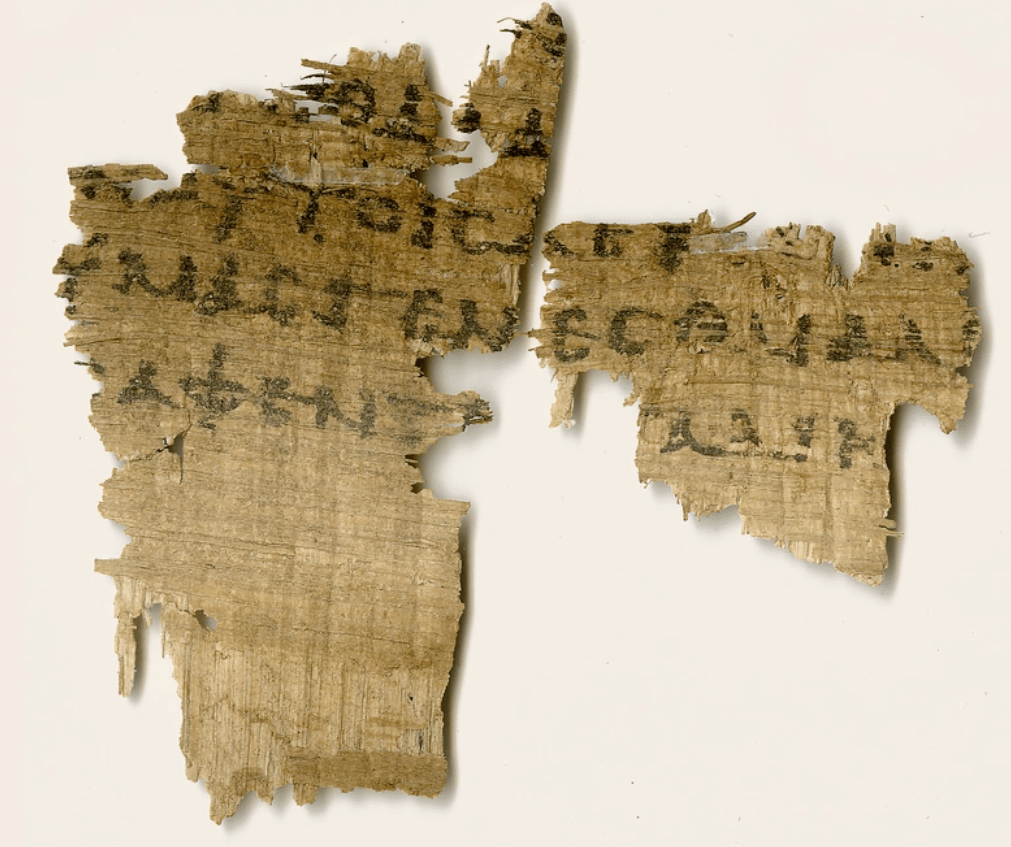
This article in the Atlantic tells a fascinating story of antiquities theft, cover-up, and fraud. The basic topic was attention grabbing. But I was positively arrested by the opening scene, because I remember watching it quite distinctly:
On the evening of February 1, 2012, more than 1,000 people crowded into an auditorium at the University of North Carolina at Chapel Hill. The event was a showdown between two scholars over an explosive question in biblical studies: Is the original text of the New Testament lost, or do today’s Bibles contain the actual words—the “autographs”—of Jesus’s earliest chroniclers?
– Ariel Sabar, The Atlantic
On one side was Bart Ehrman, a UNC professor and atheist whose best-selling books argue that the oldest copies of Christian scripture are so inconsistent and incomplete—and so few in number—that the original words are beyond recovery. On the other was Daniel Wallace, a conservative scholar at Dallas Theological Seminary who believes that careful textual analysis can surface the New Testament’s divinely inspired first draft.
They had debated twice before, but this time Wallace had a secret weapon: At the end of his opening statement, he announced that verses of the Gospel of Mark had just been discovered on a piece of papyrus from the first century.
I had watched this debate during my deconversion Journey, and at the time I was still a Christian and looking hard for answers. In my quest for balance, I watched nearly every debate on Biblical accuracy that I could find on YouTube. Titans of the battle included William Lane Craig, Christopher Hitchens, Bart Ehrman, Daniel Wallace, and others. I remember when Wallace broke out this secret weapon.
But I had been disillusioned by Craig, when in a different debate he had misused Bayes’ Theorem in an attempt to prove Jesus’ resurrection. I considered it an underhanded play, calculated to fool non-mathematical viewers, and it angered me. The Wallace theatric gave me similar unease.
Suffice to say that after Sabar’s opening vignette, I strapped in to read the remainder of this (very) long, intriguing piece. Featured characters include: Hobby Lobby, Baylor University, Oxford, DTS, shady antiquities dealers, etc.
The tale concludes as skeptics already knew it would: with advocates of Christianity either having lied for Jesus or merely been credulous magnets for bamboozelment (again). It still saddens me, the whole enterprise. Faith claims to be able to believe believe without evidence, but behold what thresholds are crossed to get evidence anyway, even if false.
 Jericho Brisance
I have been watching this unfold over the last couple years through the play-by-play on Brent Nongbri’s blog. Wallace appears to be an innocent victim, and the Museum of the Bible looks to have had no illicit intentions – but they let their “apologetic” quest get the best of them and failed massively with their due diligence, or lack thereof . This is an unfortunate human trait, in that we tend to form blind spots wherever there are threats to our hopes and allegiances.
LikeLiked by 1 person
That looks like a great blog, I followed it. And yes, the whole thing sounded like a very long, awful reveal. It became truly surreal when it got to the bit about buying a castle (what the what?).
The questions of “innocent victim” is one I struggle with though. Not specifically here, but surrounding faith issues overall. Just to take to the common person, I’ve had and still have some undiscerning, deeply religious relatives that promote easily Snopes-able articles. They pass them around, forward them, broadcast them. My routine approach was to at least try to politely point them to Snopes, and explain that its fairly easy to do quick sanity checks before passing along. The response was always odd. No apologies, no real acknowledgement, and definitely no stopping. Boneheaded sources continued to flow.
I have no doubt they were suckered, and they believed what they were sending. But there is also no doubt that they are part of the problem, that they ought to feel some impingement on their conscience, and that they need to take on adult-level responsibility. Because they are indeed broadcasting nonsense.
Primates have wet-ware issues. That goes for all of us, of course. But minds that run on faith are doubly vulnerable. They have accepted as an epistemology a framework that ritually accepts a great deal on insufficient evidence. Not surprising when they accept artifacts the same way. And that makes them anything but innocent. It really makes them not a lot different from people who won’t Snopes those articles. They owe the people in their orbit something better.
I dunno. Still wrestle with this one at times. When we have to ask whether we’re really dealing with ‘good people,’ and who is victim vs victimizer.
LikeLike
I see it as being about trust in one’s community. We don’t have resources or the capacity to verify everything for ourselves, and I think a tendency to trust our tribe and it’s traditions has probably made its way into our wet-ware because it is valuable to do so more often than not. There was a great blog post about a year ago that really helped me see this. Religion is one particular vehicle for reinforcing this dynamic, but politics, or any other tribal affiliation, can do the same. Maybe there is some additive factor due to the religious epistemology, but I think it’s secondary.
LikeLiked by 1 person
Good point. That last bit is interesting. Taking a memetic point of view, religion could have evolved by exploiting it, and succeeded because it did. And thereafter it amplifies it. Something like how the Abrahamic faiths establish doctrines about reproduction, exploiting a natural behavior to perpetuate themselves more broadly. Dawkins, Dennett.
LikeLiked by 1 person
Regarding his conversion and faith in Jesus Christ, Ehrman said, “For me, at the time, it felt like an enormous relief, a lifting of burden, a sense of connecting with the universe in a way I never had before. Very powerful!” “At that point Jesus became not only my Lord and Savior, but also my best friend and closest ally.” “Jesus was my model of self-giving love…”
Poor Bart. He left his best friend because evil became too abundant. When Christ became not only his best friend, Lord and Savior, but his model of self-giving love, the amount of evil in those days was measurably less than when he departed ways. Hitler had not slaughtered 6 million Jews, Stalin 20 million worthless citizens, etc.
Dylan was trying to hustle you, too, when he wrote:
“I believe in you even through the tears and the laughter
I believe in you even though we be apart
I believe in you even on the morning after
Oh, when the dawn is nearing
Oh, when the night is disappearing
Oh, this feeling is still here in my heart
Don’t let me drift too far
Keep me where you are
Where I will always be renewed
And that which you’ve given me today
Is worth more than I could pay
And no matter what they say
I believe in you”
You don’t want to read the testimonies of millions more who are just trying to make a qwick buck off you. Millions and millions and millions and millions…
LikeLike
Faith and evidentialism cannot coexist. If something can be believed based on evidence it cannot also be believed on faith, and yet faith is the cornerstone of all religion belief. They are antithetical. The minute evidence appears faith is cast aside in favour of evidence. The apologist leaps between the two, always shifting the value of one over the other, then back again. It’s maddening.
Good to see you back around, dear boy. Trust all is well.
LikeLiked by 3 people
Hello John, great to ‘hear’ your voice again.
Agree entirely with what you said. As I mentioned to Travis, I view primates as definitely having wet-ware issues. That goes for all of us, of course. But minds that run on faith are doubly vulnerable. They have accepted as an epistemology a framework that ritually accepts a great deal on insufficient evidence. Not surprising when they accept artifacts the same way.
You’re very right about apologists. In my angrier days, I took to saying that apologist was just another word for conman. There is some truth to that in my view, but I’ve moderated a bit. They seem to play a conflicted dual role of mark and conman all at once.
Yes, glad to say all is well. I think it took three years away to really reset my identity though. Life was defined by religion, and then came to be defined by opposition to religion. I’d like to think we’re in a better place now, where life is defined by other things. Bringing this site back from the dead was an odd experience. I had forgotten about a lot of what was here. Like a time capsule.
LikeLiked by 2 people
Go make a sun. Get back to us the moment you do.
LikeLike
I believe cars move. I believe the sky is blue. I believe water turns into ice and steam. I believe wind is air that moves. I have confidence when steam is blasted through a whistle it screams. I have faith babies are born.
GOD never asked anyone, ever, to believe in Him without evidence that He is and that He is a rewarder of those who diligently seek Him. Not once. I believe in/have faith in God because He has made it very clear that He exists. My god man, what’s wrong with people? Take a breath without Him. Good luck.
LikeLike