Solipsism – an Illustrated Definition (YouTube)

Some readers have been intrigued by my use of the word solipsism. What does it mean? Well, we could go by the Dictionary.com definition, but that’s a little on the boring side:

Solipsism – an extreme preoccupation with and indulgence of one’s feelings, desires, etc.; egoistic self-absorption.

I’m afraid that I would never have called my faith a solipsism. Isn’t Christianity all about dying to self? Yes, in many ways. And no, in so very many others. I submit the following “illustrated definition” for consideration. Caricatures can be instructive, and they can cause us to rethink things to which we are blinded by familiarity:

http://www.youtube.com/watch?v=sd7iXASIOdA

I’d have to say that I’m guilty of all these things. The retrospective has been a hard swallow.

~

Ref: https://www.youtube.com/user/TheThinkingAtheist


Marco’s Daddy and the Beginning of Life on Earth

Two Fingers ManHow can my great-great grandfather, Marco, help clarify how we view the beginning of life and the universe? Well, interesting question. Though it will take us circuitously through a barking-mad courtroom, a mock trial, and some rather startling suggestions regarding my own ancestry, the final picture should be crystal clear.

But first things first: a little background. There are two questions that demand (!) an answer.

Just Two Simple Questions

I have friends who are creationists, as indeed I myself once was. We’ve been dialoguing quite a lot since the Ham-on-Nye debate not long ago. So much so, that I have had to put aside some previously planned blog projects and such, and I’ve been spending my time fielding science sorts of questions instead. Or at the very least, I’ve been trying to. [Read more…]

Ravi Apologist Bingo

I have had friends deeply enamored with Ravi Zacharias, but I have found his writing and lectures to be tepid and maddening, respectively. Those who are not familiar with the works of better minds mistake Ravi for a sort of CS Lewis-like figure, or a great intellectual. He doesn’t rise to Lewis’ wasteline, I am afraid. He regurgitates the work of others, and he possesses an unfortunate dimension that was essentially absent from Lewis’ work: malice. Lewis always maintained an eye toward evangelism – really reaching to people outside the church. Ravi’s drivel is perfect cheering fodder for those who already agree with him, but little more.

I was, as such, quite pleased with the cleverness of this wonderful new game: Ravi Apologist Bingo!

http://www.patheos.com/blogs/friendlyatheist/2014/02/17/this-is-a-powerful-way-to-combat-a-christian-speaker-at-your-university/

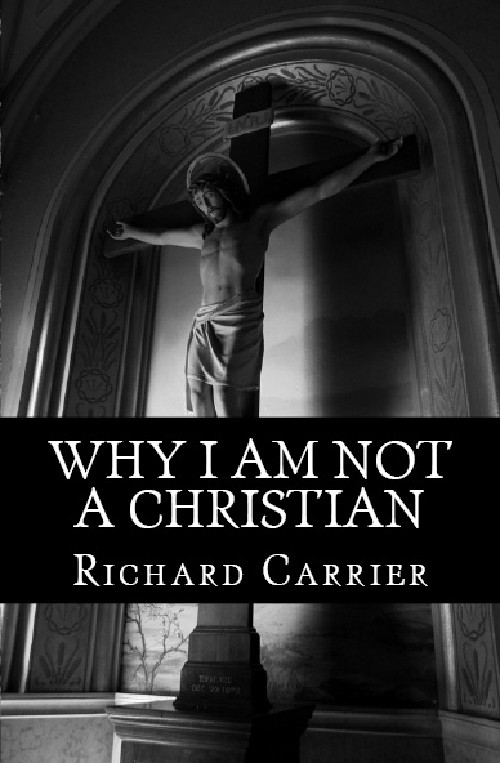
Quote – Richard Carrier, “Why I Am Not a Christian”

I’m cognitively defective. Or that’s what Christians tell me. It’s not true, of course. But the curious thing is how desperately they need to believe there is something wrong with me. For otherwise, they cannot explain how someone so well informed about their religion could reject their faith—indeed, someone who doesn’t just give it a pass, but rejects it as firmly as any other bizarre cult or superstition. Which is what it is. This book is about why.

Carrier, Richard (2011-02-28). Why I Am Not a Christian: Four Conclusive Reasons to Reject the Faith (Kindle Locations 35-38). Philosophy Press. Kindle Edition.

~~~

Well, on the background of some responses that I’ve received during my exodus from the faith, I certainly resonate with the felt diagnosis from others. And the more people I converse with, the more I realize how common this viewpoint is… and how guilty I myself have been of the same.

Geographically Embarrassed

Well, when you put it that way, yes. There are a few spots that need to be included, probably with an odd “splat” shape that has fingers here and there. But the point is well taken.

john zande's avatar

CIRCLE

View original post

YouTube: Dawkins on Cargo Cults

I first read about the Cargo Cults from Hitchens, then found another such discussion from Dawkins. I was glad to see that the Dawkins chapter has been captured on YouTube with some, albeit not terribly extensive, footage of the believers themselves. Here I will venture only three brief observations:

1. Modern, Western people possess no genetic superiority to these villagers. We are running the same mental “hardware”, so to speak. The only difference is that we are educated and indoctrinated differently.

2. Christianity was started among an initial crop of believers with generally low levels of education and literacy, in a poor and oppressed region. And it was rejected as nonsensical by the educated class of the same region.

3. Arguments made by NT Wright and others that fully-orbed religions such as Christianity require long periods of time to develop are simply mistaken. And like the Cargo Cults, Christianity can be demonstrated as having acquired nearly all of its material from prior myths and cults.

Part 1:

Part 2:

Reblog: “My Journey to Atheism” ~ Nathan Pratt

Reblog:

Nathan Pratt pens an impactful autobiography in this post, which provided me with a number of strong resonance points as I read it. His path away from Christianity came from a different angle, but the struggle to understand and the responses from others in his life are eerily familiar. A recommended read. I wept.

Nate Pratt's avatarunpacked thoughts

Something I’d like to get out of the way immediately is that this post is going to be very honest. It’s a brief history of my religious upbringing, my crisis of faith and the final pushes to search for truth. Nothing I’ll say in this post is said out of anger or malice. It’s an honest portrayal of the extreme difficulty of leaving something you’d held to be truth for almost 30 years. I imagine that some of the topics and points will offend, but please read to the end.

One of the more frustrating things to come out of leaving religion is that so many theists think I haven’t thought this out. That I’m just going through a phase. I’d be willing to wager that I’ve gone much farther in my pursuit of truth than about any believer out there. I’ve put a staggering amount of time into this journey…

View original post 4,033 more words

iGod, Part 1 – Divine Uplink

The Holy Spirit is that little piece of me that I like to call God.

Red Telephone

Red TelephoneNot long ago, a friend sent an email announcement to me and some others, outlining a plan to go into the missionary field. The email cited God’s leading and their prayerful consideration. It also stated that this consideration had begun when he heard God speak to him, audibly. I’ve heard claims to hear the audible Voice of the Lord before, but I will admit that it has been some time. And as with everyone I’ve known who claimed to have received the Big Call on the red telephone, the experience left my friend brimming with a sense of calling and purpose. The conversation that followed between us was both respectful and quite long. The story sounded so very familiar. It sounded like a story that I myself would once have told.

To Walk by the Spirit

In my younger days, I walked in the Spirit quite fervently, or so I thought. [Read more…]

Infographic – Evolutionary Tree of Myth and Religion (reblog)

In keeping with my affinity for educational visual aids, I simply couldn’t resist adding this one to the lineup. Excellent work from Simon Davies @ www.Facebook.com/HumanOdyssey. Thanks to Seth Andrews at TTA for the Facebook post.

My own thoughts… I had a conversation with a friend quite recently, and he asked me what I thought “the truth” was. I told him that at bottom, I think religion is simply something that people like to do. We fear death. We fear uncertainty. And we fear insignificance. Religion gives us an incantation against the parts of our own minds that grasp these realities. Further, we Christians are not special, and we do not have corroborating evidences that our competing faiths lack. The mirage of uniqueness grows from the soil of ignorance. We do not understand “the others”, and so we do not understand ourselves. Only deep reading about our faith from outsiders, and about other faiths from insiders, will dispel the fog. And visuals like this are an excellent help.

Mythology Tree of Descent

As a Matter of Fact

The entire discussion of Christian apologetics would be greatly served if there was a clearer appreciation of a critical distinction: that of (1) facts and (2) contentions.

  1. Fact: A fact is something that has really occurred or is actually the case. The usual test for a statement of fact is verifiability, that is whether it can be proven to correspond to experience. (ref)
  2. Contention: a point contended for or affirmed in controversy. (ref)

The subtle trick of apologetics is get that rubber stamp out: labelling contentions as facts is job one. We do not like doubt. When in doubt, stamp it!

A Recent Comment

One of my commenters recently posted the following:

The foundation of the Christian religion is not in fuzzy emotions or the logical coherence of its theology, but in a historical event: the resurrection; that it occurred, that there were many eyewitnesses to it, and that many of those eyewitnesses died attesting to it.

I formerly believe and said exactly the same thing. But is the resurrection a fact, or a contention? [Read more…]

Quote: Richard Carrier on Christianity

I’m sorry to say that, after 35 years as a Christian, yes, this is what we believe.

Definition of Christianity #1: Fundamentalist Version:

The belief that some cosmic Jewish zombie can make you live forever if you symbolically eat his flesh and telepathically tell him that you accept him as your master, so he can remove an evil force from your soul that is present in humanity because a rib-woman was convinced by a talking snake to eat from a magical tree.

~ Richard Carrier, Lecture “Are Christians Delusional?”, Skepticon 3

Definition of Christianity #2: Liberal Version:

All that Eve stuff is baloney. But I still have an imaginary friend who manipulates the world for me, and he also magically impregnated a woman two thousand years ago, and she bore him a son who underwent an ancient ritual of blood sacrifice in order to dispel a curse laid upon me, thus ensuring that I will be immortal (although I’ve never seen this work for anyone else before).

~ Richard Carrier, Lecture “Are Christians Delusional?”, Skepticon 3

Jesus’ Atonement:

God needs blood to fix the universe, but only his own blood has enough magical power to do it, so he gave himself a body and killed it.

~ Richard Carrier, Lecture “Are Christians Delusional?”, Skepticon 3

Quote: Daniel Dennett, Breaking the Spell

Daniel Dennett, at the Second World Conference...

Daniel Dennett, at the Second World Conference on the Future of Science, in Venice, 2006 (Photo credit: Wikipedia)

There is an asymmetry: atheists in general welcome the most intensive and objective examination of their views, practices, and reasons. (In fact, their incessant demand for self-examination can become quite tedious.) The religious, in contrast, often bristle at the impertinence, the lack of respect, the sacrilege, implied by anybody who wants to investigate their views.

~ Dennett, Daniel C. (2006-02-02). Breaking the Spell: Religion as a Natural Phenomenon (pp. 16-17)

In my own limited personal experience, I can attest that this quote resonates with reality. Not everyone bristles, of course, though some do. I think maybe the bristling is saved for outsiders, and I was an insider.

Some of my friends have simply acted uncomfortable. A number have flatly not wanted to hear or know anything about my investigation. Yet several have actually thought even my very attempt at examination was foolhardy… I wish I could count the number of times I’ve been told that the project of investigating the claims of Christianity simply cannot be transacted, that is flatly impossible, and that it lies beyond critical inquiry. There is a pretending that our faith is made of “faith stuff” that never touches earth, a pretending that Christianity does not make claims about history that can be checked.

We Christians claim a trove of knowledge. Human knowledge can be checked, can be examined, and can be disconfirmed. There are no grand exemptions. Just as Christians would say that Islam is objectively wrong, and could provide reasons why this is so, likewise our own views can be examined under the same cold light of inquiry. We have enjoyed our own proclaimed asymmetry far too long. And we are increasingly being called on it.

Dennett argues that we should conduct such inquiry for religion in general, and with vigor. I agree.

Infographic: The Breaking of Christian Apologetics

Collapse of ApologeticsIn thinking back over the course of my own investigations, I have noted that several criteria have proven useful again and again. As a person investigates issues of faith and compares different explanations, these principles of vetting can help clear away the clutter that is so happily foisted by various authors. I have dubbed the following five criteria:

  1. The Goose and the Gander
  2. The Burden of Proof
  3. Scaled Support
  4. The Weakest Link
  5. Alternate Cases

In my own investigations, I have found that the most robust cases raised by the mightiest Christian apologists cannot survive the winnowing.

The Goose and the Gander

Principle:

If a rationale can be used to support more than one religion, that line of argument cannot be considered definitive. What is good for goose and the gander cannot adjudicate between them.

Example:

Eyewitness testimony from believers living at the time of Jesus does count as type of evidence. However, it is not unique or definitive evidence. Other religions make similar claims on similar grounds by people who similarly believed. [Read more…]

Christian Agnosticism & Touching Earth

English: Arabic Question mark 한국어: 아랍어에서 사용하는 물음표

I have recognized a repeating pattern from my past conversations, both in person and online, which I believe lies at the very bedrock of believer’s objections to investigative discussions regarding belief, Christianity, and the Bible. Once evidential discussions have run their course, and once a retreat is beaten from that battlefield, believers will very often default to the inner keep of last resorts:

You cannot evaluate the truth of Christianity with analysis or reason or rational argument: you must either believe it on faith or not at all. It is about belief. It requires faith.

I have come to call this a “retreat to grey”, the falling back to a proposition that faith knowledge is different by category from other knowledge – as different as living organisms and dead stones. Things of the spirit cannot be interrogated by the same means as other truth claims. At bottom is an agnostic claim: we simply cannot “know” things in this realm, nor prove them, and certainly not disprove them, by any path of critical thinking or evidence.

But why do we think this? [Read more…]

Reading the Wrong People

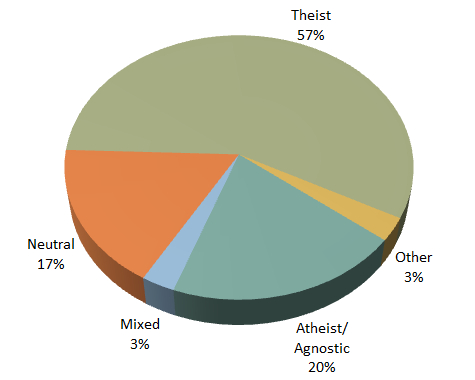
Table of Major Written WorksSome friends have considered that my departure from Christianity must be due to a misplaced emphasis of the sources that I have consulted. That is, perhaps I spent too much time reading “the wrong people”, and so came to bamboozlement. This is a legitimate concern, and I suspect that it may be more broadly held than I would hope. It struck me as incorrect on first blush, but I did go back and actually catalogue my sources by worldview.

Taking only the major written works that I read (a few dozen), the statistics sum as shown in the first chart. As can be seen, theist sources dominate the atheist/agnostic sources by 3 to 1. Neutral sources included generic information without direct bias or commentary on Christianity one way or another, while the mixed category denotes resources like “multi-view” type books.

Table of All SourcesIf the net is cast more broadly and extended to include all resource types – including shorter articles, book reviews, Wikipedia entries, and the many debates and lectures that I have watched – the percentages shift as shown in the second pie chart (130+ total).

For myself, I can find no intrinsic indictment in these statistics, nor a visible dereliction of duty, nor an inundation of dreaded atheistic slant. Rather, the collection represents a range of viewpoints, and it favors Christian-biased sources more heavily than any other segment.

Yes, I must maintain, it is possible to become convinced that Judaism and Christianity face intractable problems as a result of a well-rounded, detailed, and broad-based research effort. My conclusions have not been for lack of consulting Christian scholarship. After all, that was my fortress of first retreat. But the vanguard within those walls sadly could not answer…

See the Review of Sources and the Bibliography for detailed lists.

The Curious Case of Alireza M… Thoughts on Resurrection and Being “Mostly Dead”

nooseAn astonishing news story was posted by CNN this morning, with the following highlights:

Convicted by an Iranian court of possessing a kilogram of crystal meth, the 37-year-old man was sentenced to death by hanging at Bojnurd Prison in northeastern Iran, according to Jam-E-Jam, an official newspaper that offered this wince-inducing account:

On the morning of October 9, Alireza M. was taken from his cell to the gallows, where the judge who had issued the order read his sentence aloud and official papers were signed.

Then, a rope was placed around his neck and he was hanged for 12 minutes, after which his body was lowered and a doctor declared he was dead. The doctor, the judge and the prison head then signed the death certificate, and the body of Alireza M. was taken to a morgue for delivery the following day to his relatives.

But the next day, a worker at the morgue noticed that plastic encasing one of the bodies had steam in front of the mouth.

Consider the tally:

  • Executed by suffocation…
  • By professionals that carry out such executions for a living…
  • Death witnessed by multiple people…
  • Dead body lowered and inspected…
  • Carried away, wrapped, and laid on a flat surface

I can think of one notable case where this sort of thing happened before. [Read more…]

Bringing the argument home to the apologists

As an engineer, I have considered that illustrations would be of great benefit in clarifying the various issues surrounding the Bible and adverse evidence. This illustration was absolutely spot on per my own observations from the past year’s study.

One of my critiques of Plantinga‘s “Where the Conflict Really Lies” was that he made a project of defending a streamlined and generic theism, only to leap to a conclusion that Christianity was therefore more reasonable than non-belief. This illustration depicts precisely the downfall of the entire book. And such conflations abound everywhere.

As I have posted elsewhere, theism or deism may possibly be true, but that does not save Christianity. The Bible’s credibility collapses on the great weight of disconfirming evidences and the many textual ascription crises.

Phil Stilwell's avatardeconversion

The good news is that today’s apologists find their own core belief indefensible. This is leading to an attempt to draw the debate away from the many core logical absurdities found in the “gospel”, and to a focus on arguments absent from what has lead most of them to their faith. These are just a decoy. Any proposal of a spherical cube of gold can be immediately dismissed due to the impossibility of a spherical cube, evidence of gold not withstanding. In like manner, any proposal of the logically impossible Christian god can be dismissed based on the impossibility of that god, in spite of proffered evidence of “changed lives” or “fine tuning” or perceived weaknesses in evolutionary theory or the need for “objective purpose”. Whatever gods may exist, the logically impossible god of the Bible is disqualified as a candidate due to his logical incoherence. Let’s avoid the intentional…
View original post 16 more words

Quote from a Former Hero: Augustine

“There is another form of temptation even more fraught with danger… This is the disease of curiosity. It is this which drives us on to try to discover the secrets of nature, those secrets which are beyond our understanding, which can avail us nothing, and which men should not wish to learn.”

~ St. Augustine. Quoted by McGowan, Dale (2011-02-15).

Parenting Beyond Belief (pp. 201-202). Amacom

I cannot but reflect that such repressive attitudes would have kept us in darkness without daybreak. The medicine which saved my daughter would not have been developed without the sustained drive of many minds who divorced themselves from such shackled “thinking”.

Quotes from a Former Hero: Luther

Reason is the Devil’s greatest whore; by nature and manner of being she is a noxious whore; she is a prostitute, the Devil’s appointed whore; whore eaten by scab and leprosy who ought to be trodden under foot and destroyed, she and her wisdom … Throw dung in her face to make her ugly. She is and she ought to be drowned in baptism… She would deserve, the wretch, to be banished to the filthiest place in the house, to the closets.

~ Martin Luther, Erlangen Edition v. 16, pp. 142-148

There is on earth among all dangers no more dangerous thing than a richly endowed and adroit reason… Reason must be deluded, blinded, and destroyed.

~ Martin Luther, quoted by Walter Kaufmann,

The Faith of a Heretic, (Garden City, NY, Doubleday, 1963), p. 75

People gave ear to an upstart astrologer [Copernicus] who strove to show that the earth revolves, not the heavens or the firmament, the sun and the moon. Whoever wishes to appear clever must devise some new system, which of all systems is of course the very best. This fool wishes to reverse the entire science of astronomy; but sacred scripture tells us [Joshua 10:13] that Joshua commanded the sun to stand still, and not the earth.

~ Martin Luther, “Works,” Volume 22, c. 1543

We know, on the authority of Moses, that longer than six thousand years the world did not exist.

~ Martin Luther, “Lectures on Genesis”

These and further citations here.

Long Reads and Wikipedia

After a year of reading and looking, I arrived at the place of conceding that scholarly consensus about the authorship of the Bible gives a pretty low score to the traditional ascriptions. The best information today indicates that many books were not written by who we thought or when.

Wikipedia - BibleThe ironic and painful part of this is realizing that the answer could have been found very quickly and easily – by simply reading the Wikipedia entry on authorship of the Bible. Heavily annotated, the basic viewpoint there comports with the net information that I’ve seen. That’s sort of sad. If I wanted to know the skinny on the Book of Mormon or the Koran, the first place I would go would be Wikipedia. It was one of the last places I went on Biblical texts. We are very accustomed to learning about our religion from inside our religion.

Authorship: http://en.wikipedia.org/wiki/Authorship_of_the_Bible

The Exodus: http://en.wikipedia.org/wiki/The_exodus

The Flood: http://en.wikipedia.org/wiki/Flood_geology

SoundEagle 🦅ೋღஜஇ

Where The Eagles Fly . . . . Art Science Poetry Music & Ideas

Michael Seidel, writer

Science fiction, fantasy, mystery and what-not

cas d'intérêt

Reflections of a Francophile

Two Wheels Across Texas

My Quest to ride through all 254 Texas Counties

She Seeks Nonfiction

Social justice book reviews

Uncommon Sense

I don’t want to start a class war; it started a long time ago and, unfortunately, we lost.

Variant Readings

Thoughts on History, Religion, Archaeology, Papyrology, etc. by Brent Nongbri