When I read the Book of Mormon, I feel closer to Jesus Christ.

Mormon Ad

This ad appeared on the CNN home page today and if clicked will take you here.

In a single sentence, this ad illustrates the problems outlined on one of my prior pages, Faith Card. Our existential sense of spiritual truth simply does not work. It is not a barometer of fact or fiction. It is not a compass that leads to anywhere. Our intuition does not work where spiritual matters are concerned. Well meaning, “faithful” people are all radically divergent in the direction their respective compasses point.

Pleasant Mormons like this young woman, far from being in the service of the devil, are doing the best they can. But they have been hampered by an unfortunate paradigm, which claims that the really important things in life must be known by faith. This general belief, that faith is the mechanism by which we know spiritual truth, is shared by the broad range of religions. And it is a demonstrably ineffective and wayward mechanism.

Faith constitutes a proposal regarding process… “This is how you find ultimate truth.” Your internal sense of relationship or spiritual presence should be your guide. That burning of the bosom should be your guide. Truth feels a certain way when you have it. You know, because it sounds right. You know because you know. You know because of your sacred texts. But at bottom, this type of knowing is followed by everyone in religions that oppose yours.

The cleverest part of faith, however, may be found in a self-validating defensive mechanism. Faith concurrently makes objective knowledge claims while maligning the validity of the one process which can call it’s bluff: critical thinking. Answers to the most pressing questions, we are told, can only be known by faith. Study, analysis, science, and the like are all said to lose their potency where ultimate questions are concerned. “You cannot answer these questions through such means,” comes the admonition from those who have never actually tried.

Belief in belief: the tragedy that all religions share.

I encourage my Christian readers to visit the Mormon website linked above. I would further encourage reading of Buddhists and other faiths. You will see a repetition of themes in how religious viewpoints are defended, advanced, and arrived at. The means of thinking are entirely analogous, but the specific claims are contradictory. And that should raise the question: what if faith is a flawed mechanism?

Quote: Richard Carrier on Christianity

I’m sorry to say that, after 35 years as a Christian, yes, this is what we believe.

Definition of Christianity #1: Fundamentalist Version:

The belief that some cosmic Jewish zombie can make you live forever if you symbolically eat his flesh and telepathically tell him that you accept him as your master, so he can remove an evil force from your soul that is present in humanity because a rib-woman was convinced by a talking snake to eat from a magical tree.

~ Richard Carrier, Lecture “Are Christians Delusional?”, Skepticon 3

Definition of Christianity #2: Liberal Version:

All that Eve stuff is baloney. But I still have an imaginary friend who manipulates the world for me, and he also magically impregnated a woman two thousand years ago, and she bore him a son who underwent an ancient ritual of blood sacrifice in order to dispel a curse laid upon me, thus ensuring that I will be immortal (although I’ve never seen this work for anyone else before).

~ Richard Carrier, Lecture “Are Christians Delusional?”, Skepticon 3

Jesus’ Atonement:

God needs blood to fix the universe, but only his own blood has enough magical power to do it, so he gave himself a body and killed it.

~ Richard Carrier, Lecture “Are Christians Delusional?”, Skepticon 3

The Four Stories We Tell Ourselves About Death (YouTube)

This is a lucid TedTalk from philosopher Stephen Cave. He makes the case, albeit with TedTalk brevity, that humanity has developed many specific immortality stories based on four simple plotlines. Such stories are intended to mitigate our innate fears about death, by which people have always convinced themselves that death is not real or final. Since we can see thematic recurrences serving the same bias and human desires, it is reasonable to question the validity of any specific immortality story (i.e., Hindu, Christian, Modern, etc.). We believe such stories because we want them to be true, and not on the weight of the evidence that such stories actually are true. Historically, we have proven willing to believe pretty much anything that promises an escape hatch.

My thoughts: why do we regard faith as a virtue? Why do we condemn those that lack faith, or at least look on them as sad figures?

  1. There is no confirmable evidence that any immortality tale is true.
  2. Belief in immortality must be on faith.
  3. Those that murmur against faith are implicitly shouting that the death proposition is true.
  4. People do not want to be reminded, and they do not want to be awakened to their wishthinking. The point of faith is to forget. It is to forget our smallness and our mortality. And if faith is delegitimized, we will all have to remember.

Hence religion. So many immortality stories. So varied and creative and beautiful. So many beautiful lies, conceived in terror, and bourn by happy wishing. But lies, such as they are, prove damaging, of a squandering influence, and ultimately – entirely unnecessary.

Quote: Daniel Dennett, Breaking the Spell

Daniel Dennett, at the Second World Conference...

Daniel Dennett, at the Second World Conference on the Future of Science, in Venice, 2006 (Photo credit: Wikipedia)

There is an asymmetry: atheists in general welcome the most intensive and objective examination of their views, practices, and reasons. (In fact, their incessant demand for self-examination can become quite tedious.) The religious, in contrast, often bristle at the impertinence, the lack of respect, the sacrilege, implied by anybody who wants to investigate their views.

~ Dennett, Daniel C. (2006-02-02). Breaking the Spell: Religion as a Natural Phenomenon (pp. 16-17)

In my own limited personal experience, I can attest that this quote resonates with reality. Not everyone bristles, of course, though some do. I think maybe the bristling is saved for outsiders, and I was an insider.

Some of my friends have simply acted uncomfortable. A number have flatly not wanted to hear or know anything about my investigation. Yet several have actually thought even my very attempt at examination was foolhardy… I wish I could count the number of times I’ve been told that the project of investigating the claims of Christianity simply cannot be transacted, that is flatly impossible, and that it lies beyond critical inquiry. There is a pretending that our faith is made of “faith stuff” that never touches earth, a pretending that Christianity does not make claims about history that can be checked.

We Christians claim a trove of knowledge. Human knowledge can be checked, can be examined, and can be disconfirmed. There are no grand exemptions. Just as Christians would say that Islam is objectively wrong, and could provide reasons why this is so, likewise our own views can be examined under the same cold light of inquiry. We have enjoyed our own proclaimed asymmetry far too long. And we are increasingly being called on it.

Dennett argues that we should conduct such inquiry for religion in general, and with vigor. I agree.

From the Inbox: Dinosaur Blood and Creationist Contentions

Oh, the Drama

Tyrannosaurus rex, Palais de la Découverte, Paris

Tyrannosaurus rex, Palais de la Découverte, Paris (Photo credit: Wikipedia)

This post has turned out to be somewhat meaty, and it is permeated with a fascination real-life stage drama – dinosaurs, Jurassic Park, a good YouTube video, all intertwined with religious controversy and persecution, and wrapped up at the end with some lessons-learned and a challenge to My Fellow Christians. I hope the reader will enjoy the story as much as I have.

For my Christian readers, please do not miss the “My Fellow Christians” section at the end…

A New Type of Post

How it began… On a semi-frequent basis I now receive a range of emails from well-meaning friends on a range of subjects. I’m often sent links to science related articles. Sometimes I am sent queries about various biblical topics. I generally appreciate any information-oriented feedback. I try to take each point raised quite seriously.

After doing this several times, I’ve decided such content would make for good blog posts. I’ll post such information from time to time, always omitting the sender’s name, any personal comments, and in a generally sanitized form. I can see no reason that such information and time investment be limited in distribution to the original sender. The more information to the more people, the better. That said, here we go.

Dino Blood

A friend recently sent an email with a comment regarding dinosaur fossil finds that intrigued me. It essentially said the following: [Read more…]

Infographic: The Breaking of Christian Apologetics

Collapse of ApologeticsIn thinking back over the course of my own investigations, I have noted that several criteria have proven useful again and again. As a person investigates issues of faith and compares different explanations, these principles of vetting can help clear away the clutter that is so happily foisted by various authors. I have dubbed the following five criteria:

  1. The Goose and the Gander
  2. The Burden of Proof
  3. Scaled Support
  4. The Weakest Link
  5. Alternate Cases

In my own investigations, I have found that the most robust cases raised by the mightiest Christian apologists cannot survive the winnowing.

The Goose and the Gander

Principle:

If a rationale can be used to support more than one religion, that line of argument cannot be considered definitive. What is good for goose and the gander cannot adjudicate between them.

Example:

Eyewitness testimony from believers living at the time of Jesus does count as type of evidence. However, it is not unique or definitive evidence. Other religions make similar claims on similar grounds by people who similarly believed. [Read more…]

Christian Agnosticism & Touching Earth

English: Arabic Question mark 한국어: 아랍어에서 사용하는 물음표

I have recognized a repeating pattern from my past conversations, both in person and online, which I believe lies at the very bedrock of believer’s objections to investigative discussions regarding belief, Christianity, and the Bible. Once evidential discussions have run their course, and once a retreat is beaten from that battlefield, believers will very often default to the inner keep of last resorts:

You cannot evaluate the truth of Christianity with analysis or reason or rational argument: you must either believe it on faith or not at all. It is about belief. It requires faith.

I have come to call this a “retreat to grey”, the falling back to a proposition that faith knowledge is different by category from other knowledge – as different as living organisms and dead stones. Things of the spirit cannot be interrogated by the same means as other truth claims. At bottom is an agnostic claim: we simply cannot “know” things in this realm, nor prove them, and certainly not disprove them, by any path of critical thinking or evidence.

But why do we think this? [Read more…]

Reading the Wrong People

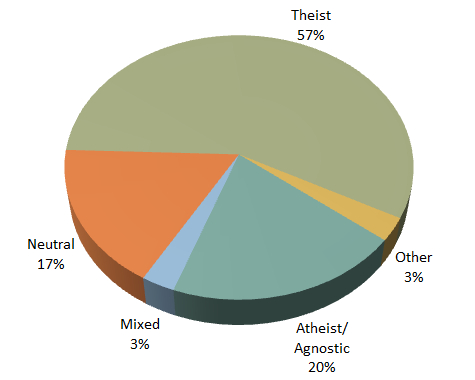
Table of Major Written WorksSome friends have considered that my departure from Christianity must be due to a misplaced emphasis of the sources that I have consulted. That is, perhaps I spent too much time reading “the wrong people”, and so came to bamboozlement. This is a legitimate concern, and I suspect that it may be more broadly held than I would hope. It struck me as incorrect on first blush, but I did go back and actually catalogue my sources by worldview.

Taking only the major written works that I read (a few dozen), the statistics sum as shown in the first chart. As can be seen, theist sources dominate the atheist/agnostic sources by 3 to 1. Neutral sources included generic information without direct bias or commentary on Christianity one way or another, while the mixed category denotes resources like “multi-view” type books.

Table of All SourcesIf the net is cast more broadly and extended to include all resource types – including shorter articles, book reviews, Wikipedia entries, and the many debates and lectures that I have watched – the percentages shift as shown in the second pie chart (130+ total).

For myself, I can find no intrinsic indictment in these statistics, nor a visible dereliction of duty, nor an inundation of dreaded atheistic slant. Rather, the collection represents a range of viewpoints, and it favors Christian-biased sources more heavily than any other segment.

Yes, I must maintain, it is possible to become convinced that Judaism and Christianity face intractable problems as a result of a well-rounded, detailed, and broad-based research effort. My conclusions have not been for lack of consulting Christian scholarship. After all, that was my fortress of first retreat. But the vanguard within those walls sadly could not answer…

See the Review of Sources and the Bibliography for detailed lists.

The Curious Case of Alireza M… Thoughts on Resurrection and Being “Mostly Dead”

nooseAn astonishing news story was posted by CNN this morning, with the following highlights:

Convicted by an Iranian court of possessing a kilogram of crystal meth, the 37-year-old man was sentenced to death by hanging at Bojnurd Prison in northeastern Iran, according to Jam-E-Jam, an official newspaper that offered this wince-inducing account:

On the morning of October 9, Alireza M. was taken from his cell to the gallows, where the judge who had issued the order read his sentence aloud and official papers were signed.

Then, a rope was placed around his neck and he was hanged for 12 minutes, after which his body was lowered and a doctor declared he was dead. The doctor, the judge and the prison head then signed the death certificate, and the body of Alireza M. was taken to a morgue for delivery the following day to his relatives.

But the next day, a worker at the morgue noticed that plastic encasing one of the bodies had steam in front of the mouth.

Consider the tally:

  • Executed by suffocation…
  • By professionals that carry out such executions for a living…
  • Death witnessed by multiple people…
  • Dead body lowered and inspected…
  • Carried away, wrapped, and laid on a flat surface

I can think of one notable case where this sort of thing happened before. [Read more…]

Infographic – Timeline of the New Testament Books

One of the many difficulties the New Testament presents for scholars is dating and sequencing the books in order. Some of the books were written anonymously and did not specify an author. Dating of documents was also not undertaken. Using a range of textual clues, scholars have developed approximate dates for the books. While timelines can be found from a number of sources, I had trouble finding any that were annotated with other significant events of the period. Thus, the following timeline, which combines information from several resources.

My hope is that this may serve as a fairly rich “info-graphic” to help outline the development of Christology and “historical” information about Jesus as contained in the gospels. (please do advise if you find any errors)

New Testament Timeline - JerichoBrisance

The core timeline – which consisted of only the books and their dates – was drawn from Raymond E. Brown’s Introduction to the New Testament (RC); and I found it in a post by Jared Anderson at RationalFaiths.com (LDS). Other sources consulted are cited below. The following is a brief excerpt from Wikipedia on Raymond E. Brown:

The Reverend Raymond Edward Brown, S.S. (May 22, 1928 – August 8, 1998), was an American Roman Catholic priest, a member of the Sulpician Fathers and a prominent Biblical scholar of his era.

Brown was one of the first Roman Catholic scholars to apply historical-critical analysis to the Bible.

He was regarded as occupying the center ground in the field of biblical studies, opposing the literalism found among many fundamentalist Christians while not carrying his conclusions as far as many other scholars.

Theological Evolution

When surveying the letters of Paul and the gospel accounts, it is interesting to note the development of historical claims, as outlined in the orange numbered callouts on the timeline. [Read more…]

Quotation: Voltaire on Miracles

Marble. In the collection of the National Gall...The daughters of the high priest Anius changed whatever they chose into wheat, wine or oil.

Athalida, daughter of Mercury, was resuscitated several times.

Aesculapius resuscitated Hippolytus.

Hercules dragged Alcestis back from death.

Heres returned to the world after passing a fortnight in hell.

The parents of Romulus and Remus were a god and a vestal virgin.

The Palladium fell from heaven in the city of Troy.

The hair of Berenice became a constellation.. . .

Give me the name of one people among whom incredible prodigies were not performed, especially when few knew how to read and write.

~ Voltaire, Miracles and Idolatry, cited from Hitchens (2007)


Dangled Over a Flame: Jews and Jesus Among Pagan Gods

Justin Martyr

Justin Martyr (Photo credit: Wikipedia)

Justin Martyr provides an interesting look at apologetics in the century following Jesus’ life. His First Apology was dated to between 147 and 161 AD. Greek and Roman god worship was alive and well, and Christianity was trying to grow from the same cultural earth as these various competing religions.

To make his case, Martyr compares Christian claims about Jesus to the existent mythology of the culture. It must be noted that the pagan themes and beliefs pre-existed Christianity. They were antecedent, and Christian doctrine blossomed against this backdrop.

Martyr makes it clear that the pagans already had themes that appear in Christianity, for he makes the argument in several ways that “we propound nothing different from what you believe”, and he addresses several key areas:

  1. The Word
  2. Sonship
  3. Divine Conception
  4. Suffering and Death
  5. Resurrection and Ascension

Martyr’s leading argument (all emphasis following mine):

And when we say also that the Word, who is the first-birth  of God, was produced without sexual union, and that He, Jesus Christ, our Teacher, was crucified and died, and rose again, and ascended into heaven, we propound nothing different from what you believe regarding those whom you esteem sons of Jupiter.

[Read more…]

Visual Comparison: Genesis vs. Other ANE Myths

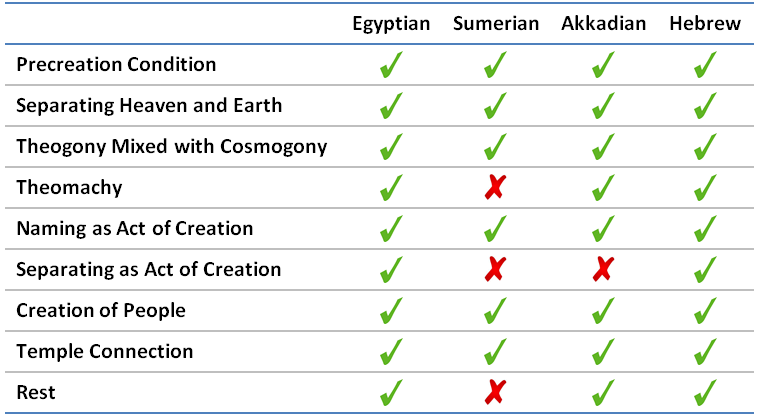
John Walton, Christian scholar from Wheaton University, presented side-by-side comparisons of various ancient near eastern (ANE) creation myths with Genesis in his book “Genesis 1 as Ancient Cosmology” (ref. 57). His tables are quite detailed, listing specific documents from Egyptian, Sumerian, and Akkadian texts (tables 2-1 and 2-2). I have created a condensed version of this information in the two tables below for quick visual comparison. The first compares theological and thematic features, while the second compares the metaphysical elements included.

It should be noted that these other cultures were far larger, regionally dominant, and antecedent to the Hebrew culture and creation account. The cosmology and thematic elements of the Genesis account were derivative of this pre-existing cultural context. Though they all differ in narrative and in theology, they are similar in how they see the world – and in what they do not see. There remains no insight in any of these myths regarding such things as:

  • Dinosaurs or extinct creatures
  • Disease-causing micro-organisms
  • A sense of cosmic scale
  • Human emergence by evolutionary descent

They are all, as it were, written at the same grade level. In terms of historical representation, they all fall down equally. But there is only one for which moderns simply will not concede this.

Summary of Features Appearing

Feature Comparison of Genesis and ANE Myths

Summary of Elements Appearing

Element Comparison of Genesis and ANE Myths

Quotation: Michio Kaku on Galileo & Bruno

English: The trial of Giordano Bruno by the Ro...

In my conversations, some have doubted that what a person specifically believes about Genesis matters. Many believers take a casual approach to the text today and cannot imagine that martyrdom has ever been joined to Genesis. Jesus perhaps, but not Genesis. To the contrary: it has carried sufficient gravity to not only execute dissenters, but to do so with leading figures, as an example. There can be little doubt what fate would have befallen Galileo had he not recanted.

From “Parallel Worlds”:

The mixture of science, religion, and philosophy is indeed a potent brew, so volatile that the great philosopher Giordano Bruno was burned at the stake in 1600 in the streets of Rome for refusing to repudiate his belief that there were an infinite number of planets in the heavens, harboring an infinite number of living beings.

Galileo’s and Bruno’s sin was not that they dared to divine the laws of the heavens; their true sin was that they dethroned humanity from its exalted place at the center of the universe.

It would take over 350 years, until 1992, for the Vatican to issue a belated apology to Galileo. No apology was ever issued to Bruno.

20 Christian Academics Speaking About God (YouTube by J. Pararajasingham)

After the past year’s study, I was astonished to learn what leading Christian thinkers actually believed about the Bible, about explanations of evil, and about cosmic/human origins. It was distressing because I believe many of these views are largely unknown to the common man in the pews. I realized just how lost our intellectual vanguard actually was, and how defeated our claims stood on the battlefield of evidence.

The following YouTube video is a compilation of 20 top Christian academics talking about God, the cosmos, the problem of evil, and other topics. Each interview excerpt is long enough not to be taken out of context, and the assemblage is very interesting. Many of these scholars were recommended to me during the past year, and they are A-listers within the Christian scholarly community. I have read their longer works and watched their lectures and debates on YouTube (N.T. Wright, Alvin Plantinga, William Dembski, John Walton, Alister McGrath, etc.). This video captures the project of textual rehabilitation and doctrinal rehabilitation that I have seen at the bottom of the bookpile, and it does so in about 25 minutes.

It illustrates what I previously wrote in the Moral Pivot:

It was our own scholars, and no one else’s, who taught me to despair.

A must watch. Kudos and thanks to J Pararajasingham. Be sure to check out his other videos on YouTube.


Bringing the argument home to the apologists

As an engineer, I have considered that illustrations would be of great benefit in clarifying the various issues surrounding the Bible and adverse evidence. This illustration was absolutely spot on per my own observations from the past year’s study.

One of my critiques of Plantinga‘s “Where the Conflict Really Lies” was that he made a project of defending a streamlined and generic theism, only to leap to a conclusion that Christianity was therefore more reasonable than non-belief. This illustration depicts precisely the downfall of the entire book. And such conflations abound everywhere.

As I have posted elsewhere, theism or deism may possibly be true, but that does not save Christianity. The Bible’s credibility collapses on the great weight of disconfirming evidences and the many textual ascription crises.

Phil Stilwell's avatardeconversion

The good news is that today’s apologists find their own core belief indefensible. This is leading to an attempt to draw the debate away from the many core logical absurdities found in the “gospel”, and to a focus on arguments absent from what has lead most of them to their faith. These are just a decoy. Any proposal of a spherical cube of gold can be immediately dismissed due to the impossibility of a spherical cube, evidence of gold not withstanding. In like manner, any proposal of the logically impossible Christian god can be dismissed based on the impossibility of that god, in spite of proffered evidence of “changed lives” or “fine tuning” or perceived weaknesses in evolutionary theory or the need for “objective purpose”. Whatever gods may exist, the logically impossible god of the Bible is disqualified as a candidate due to his logical incoherence. Let’s avoid the intentional…

View original post 16 more words

Rapid Resources Added for the Inquirer

I have added a new sidebar with rapidly-accessible resources for the inquirer (to the left). This sidebar itemizes some quick summary references – YouTube videos and articles – that do not require book-length time investment for those interested.

As I have said elsewhere, I am not a subject matter expert in archaeology or biblical studies, but those scholars are incredibly accessible for the layman.

And realizing that the bibliography page of my blog is (though useful) perhaps not the most accessible map for some of my inquiring friends, this sidebar should help provide an initial starting point.

Quotes from Rabbis & Scholars on the Exodus, Abraham

(updated 9/12/2013) The quotes below serve as auxiliary material to that already cited on my Israel’s Origins page, and I recently found them collected in a new-to-me blog. The original author cites these quotations with additional discussion, and I suggest checking it out (Thanks John Zande). The original post can be found here: Well, this is a little embarrassing, isn’t it? Meanwhile, the meaty collection of quotations:

“Defending a rabbi in the 21st century for saying the Exodus story isn’t factual is like defending him for saying the Earth isn’t flat. It’s neither new nor shocking to most of us that the Earth is round or that the Torah isn’t a history book dictated to Moses by God on Mount Sinai.”

~ Rabbi Steven Leder of the Wilshire Boulevard Temple.

“The rejection of the Bible as literally true is more or less settled and understood among most Conservative rabbis.”

~ Rabbi David Wolpe of the Conservative Sinai Temple

[Read more…]

I appreciate nothing, and a little better than I used to.

eSkeptic: Levels of Nothing 

Stimulating piece, perhaps a little slow to start, but it has a nice second half and finish.

Not everyone who leaves fundamentalism becomes an atheist

Enjoyed the lucid observations of this believer’s post.

SoundEagle 🦅ೋღஜஇ

Where The Eagles Fly . . . . Art Science Poetry Music & Ideas

Michael Seidel, writer

Science fiction, fantasy, mystery and what-not

cas d'intérêt

Reflections of a Francophile

Two Wheels Across Texas

My Quest to ride through all 254 Texas Counties

She Seeks Nonfiction

Social justice book reviews

Uncommon Sense

I don’t want to start a class war; it started a long time ago and, unfortunately, we lost.

Variant Readings

Thoughts on History, Religion, Archaeology, Papyrology, etc. by Brent Nongbri